A Guide to Choosing a Clean Sunscreen With Good Coverage For Your Kids
As summer approaches, many parents are looking for the best way to protect their kids from the sun’s harmful rays. While sunscreen is essential for preventing sunburn and skin damage, not all sunscreens are created equal. In fact, many popular brands contain chemicals that can be absorbed into the skin and can be harmful.
For those times when babies and kids are in the sun for long periods, and sunscreen is needed, make sure you are using a clean one with adequate coverage. Since babies and kids are more vulnerable to the dangers of the sun and chemicals in sunscreen, choosing a clean sunscreen is very important.

When selecting a sunscreen, always read both the active and inactive ingredients. Many ingredients have been linked to endocrine disruption, developmental toxicity, cancer, reproductive toxicity, and more so it is important to know what to avoid.
Mineral sunscreens are less likely to be absorbed into the bloodstream and are also safer for coral reefs and marine life. Chemical-based sunscreens are easily absorbed and can stay in the bloodstream for longer periods of time (sometimes up to several weeks). Chemical sunscreens may also contain ingredients that have not been determined safe or effective.
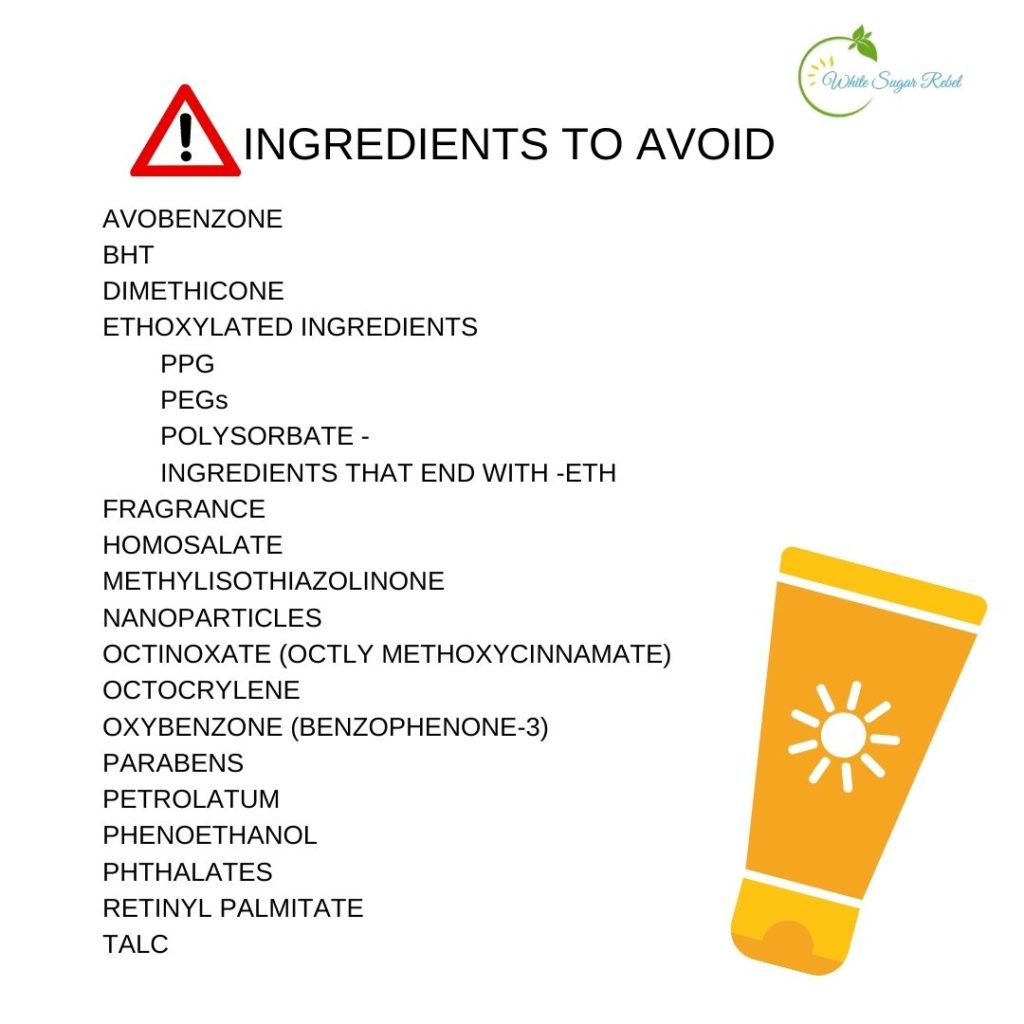
Ingredients to avoid:
- AVOBENZENE
- BHT
- DIMETHICONE
- ETHOXYLATED INGREDIENTS- PPG, PEGs, POLYSORBATE INGREDIENTS THAT END IN “ETH”
- FRAGRANCE
- HOMOSALATE
- METHYLISOTHIAZOLINONE
- NANOPARTICLES
- OCTINOXATE (OCTLY METHOXYCINNAMATE)
- OCTOCRYLENE
- OXYBENZONE (BENZOPHENONE-3)
- RETINYL PALMITATE
- PARABENS
- PETROLATUM
- PHENOETHANOL
- PHTHALATES
- TALC

More tips:
- Look for the term “Broad Spectrum” on the label to protect against both UVA and UVB rays.
- SPF greater than 50 may not provide additional protection so don’t bother with SPF greater than 50.
- SPF sprays may not provide even protection and pose the risk of chemical inhalation.
- Avoid sunscreen and bug spray combinations since they may not provide enough protection.
EWG has a great guide to refer to but I do not agree with their rating system. Some sunscreens with a 2 rating would personally rank much higher in my book. Make sure to read the ingredients if you choose to use the guide.
We use Think Sport when Alexandria is going to be out in the sun for long periods and not wearing SPF clothing. What do you use?
If you don’t see your favorite, check against the list of ingredients to avoid above
References & Resources
Abbasi J. FDA Trials Find Sunscreen Ingredients in Blood, but Risk Is Uncertain. JAMA. 2020;323(15):1431–1432. doi:10.1001/jama.2020.0792
Matta MK, Florian J, Zusterzeel R, et al. Effect of Sunscreen Application on Plasma Concentration of Sunscreen Active Ingredients: A Randomized Clinical Trial. JAMA. 2020;323(3):256–267. doi:10.1001/jama.2019.20747
Suh S, Pham C, Smith J, Mesinkovska NA. The banned sunscreen ingredients and their impact on human health: a systematic review. Int J Dermatol. 2020;59(9):1033-1042
Mitchelmore CL, Burns EE, Conway A, Heyes A, Davies IA. A critical review of organic ultraviolet filter exposure, hazard, and risk to corals. Environmental Toxicology and Chemistry. 2021;40(4):967-988.
https://www.ewg.org/sunscreen/report/the-trouble-with-sunscreen-chemicals/
https://www.cancer.org/latest-news/how-safe-is-your-sunscreen.html